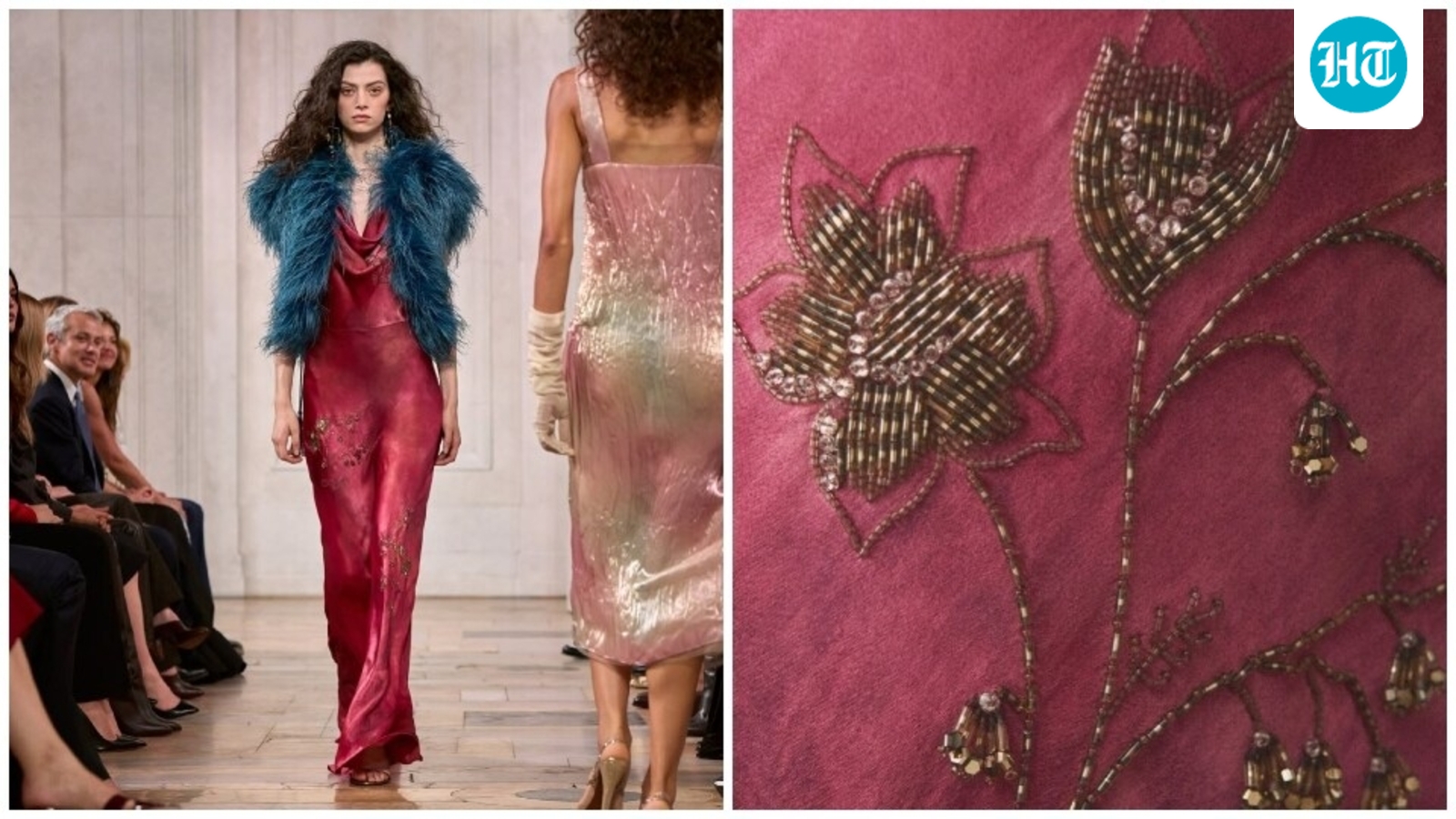
Ralph Lauren unveiled their Spring 2027 collection at the New York Fashion Week this week. Among the many looks displayed on the runway, one was an evening-wear deep pink embroidered gown, and it is now being criticised for failing to give due credit to Indian craftsmanship.
Also Read | Kareena Kapoor's elegant vintage John Galliano Baby pink skirt suit wows the Internet: ‘Poo grew up and became a CEO’
On September 12, the official Instagram handle of Ralph Lauren posted the pictures of the outfit along with a close-up shot of the embroidery with the caption, “Draped with shimmering silk-viscose and scattered with hand-applied embellishments, an eveningwear gown from #RalphLaurenSpring2027 makes a cinematic statement.”
A post shared by Ralph Lauren (@ralphlauren)
Throughout Ralph Lauren's description, there is no mention of India or the craft. The embroidery in question here is zardozi , which originated in Persia At least 300 years ago, and was popularised in India during the Mughal rule.
Prakhar Rao Singh Chandel, a fashion designer, highlighted in an Instagram post that zardozi has been registered in Lucknow and six surrounding districts since 2013, and one lakh seventy-five thousand artisans work in that cluster. He also pointed out how the Instagram post shared by Ralph Lauren eloquently describes the cloth, but the handwork gets only one word — embellishments.
He further points out that the last slide of the same post quotes Ralph Lauren himself, saying he wanted each piece to feel as though it carries its own history and character. “Whose history? Whose character?” Prakhar questioned.
Calling out international brands for repeatedly stealing Indian craft and never giving due credit, only to later apologise when caught, he added, “We already know how this goes, because we watched it last year. Prada showed Kolhapuri-style sandals in Milan in June 2025, and the show notes called them leather sandals. India was named two days after the Maharashtra Chamber of Commerce wrote to their board. That is the tactic. Say nothing, take the applause, produce the credit only once somebody forces you to. Name it when you use it. Not when you get caught.”
A post shared by Prakhar Rao Singh Chandel (@chandel.zt)
This also led to Instagram users also calling out the designer and commenting, “Start acknowledging Indian art,” “Indian embroidery inspired by Indian crafts,” “Indian art and it's done by Indian artisan,” and “Lol literally embellishments from India. Stop stealing craft.”
Someone wrote, “Racism towards Indians while actively stealing Every part of their lifestyle, culture, and the very core of their identity is a level of audacity that needs to be studied.” Another commented, “Honestly- this year somehow the cultural appropriation is off the charts.”
This is not the first time Ralph Lauren has been involved in controversy over the theft of Indian craftsmanship. In August 2026, Ralph Lauren faced intense online backlash after listing a pre-draped saree on its e-commerce platform as the "Botanical Embellished Draped Overlay Maxi Dress" priced at €198. Hindustan Times (HT City) and South Asian fashion watchdogs heavily covered the wave of criticism accusing the brand of cultural erasure.
Similarly, in March 2026, Ralph Lauren models were seen wearing bell-shaped, domed earrings resembling Indian jhumkas, which the brand labelled as “authentic vintage accessories.”
In June 2025, Prada debuted flat, T-strap leather sandals that were identical to Maharashtra’s Kolhapuri chappals during one of their showcases, sparking online backlash. The luxury brand later acknowledged the footwear’s roots in western India.
Krishna Priya Pallavi is a journalist with over 9 years of experience, covering health, fashion, pop culture, travel, wellness, entertainment, festivals, mental health, art, decor, fitness, and sex and relationships. She is an alumna of the Indian Institute of Mass Communication (IIMC), Dhenkanal, and holds an undergraduate degree in Journalism and Mass Communication from Guru Gobind Singh Indraprastha University, Delhi. Her strong academic foundation informs her analytical and detail-oriented approach to storytelling, helping her uncover stories where none seem to exist. Before joining Hindustan Times, Pallavi worked with some of India’s leading media organisations. She spent close to three years at India Today, where she honed her newsroom skills and developed a sharp editorial sensibility. She also worked for over a year and a half at Vagabomb, ScoopWhoop’s feminist digital platform, where she explored stories through a gender-sensitive, socially aware lens. Pallavi has a deep interest in global fashion trends and international fashion seasons, and enjoys interviewing celebrities and tracking pop culture movements—interests that frequently translate into engaging, reader-friendly stories. Alongside lifestyle and entertainment, she has a keen eye for impactful health and wellness journalism, regularly interacting with doctors, designers, and digital content creators to bring nuance and credibility to her work. Born and raised in Haryana, Pallavi remains deeply connected to her ancestral roots in Odisha. Her ability to spot fresh angles brings curiosity and depth to stories she pursues. When not chasing deadlines, she enjoys spending time with her dog, planning her next vacation, reading, running new trails, and discovering new destinations. Read More